
How to Choose Industrial Fans for Global Sourcing in 2026?
Choosing Industrial Fans for global sourcing in 2026 requires more than comparing catalog prices. The right fan must match the real operating system.
Michael Ivanovich, a recognized AMCA engineering authority, offers a practical reminder: “A fan must be selected for the system, not selected in isolation.” This principle remains highly relevant for international procurement teams. A fan rated at 30,000 cubic meters per hour may perform differently after duct resistance, filters, dampers, and elevation are included.
Look beyond airflow. Check static pressure, operating temperature, humidity, dust concentration, noise limits, motor efficiency, and service access. A 45°C warehouse in Dubai creates different demands than a humid food-processing site in Rotterdam. Voltage and frequency matter too. Confirm whether the motor supports 400 V, 50 Hz operation, or another local requirement.
Ask suppliers for certified performance data based on recognized procedures, such as AMCA 210 or ISO 5801. Request curves showing the duty point, efficiency, power consumption, and sound levels. Do not accept attractive numbers without test conditions.
I have seen sourcing teams choose the lowest quotation, then pay more for vibration repairs, replacement bearings, and delayed spare parts. That mistake is avoidable.
Still, no selection is perfect. Forecasts can be wrong. Production loads can change. Therefore, compare two or three operating scenarios before ordering. Review corrosion protection, controls, packaging, warranty terms, documentation, and local technical support. A reliable Industrial Fans strategy balances performance, lifecycle cost, compliance, and practical maintainability. The spreadsheet helps. Field reality decides.
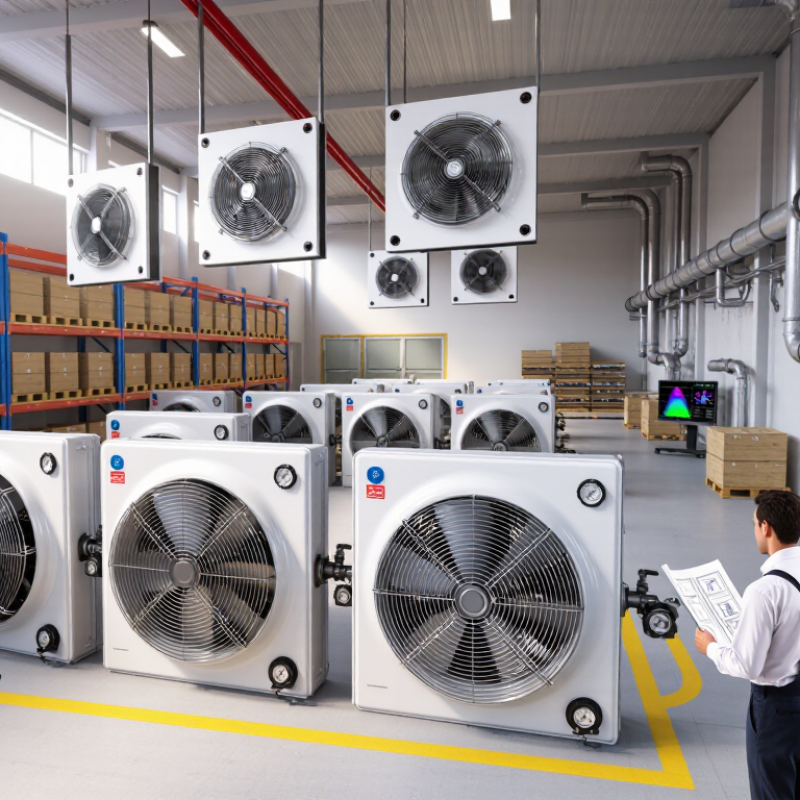
Define Airflow, Pressure, and Operating Conditions
Choosing industrial fans for global sourcing in 2026 starts with measurable air requirements. Define airflow in cubic meters per hour, not vague terms like “high volume.” Estimate room volume, heat load, dust level, and required air changes. Then calculate target airflow for the actual process.
A welding bay, warehouse, and drying line need different movement patterns. I have seen projects fail because buyers copied a catalog airflow rating. Those ratings often use free-air conditions. Real ductwork reduces performance.
Pressure is equally important. Specify static pressure for filters, grilles, bends, dampers, and ducts. Request a fan curve showing airflow at the required pressure. Check the duty point, not the maximum headline number.
Operating conditions must include temperature, altitude, humidity, corrosive exposure, dust concentration, and duty cycle. Motor power and enclosure protection should match the site. For international purchasing, ask for test methods, tolerances, drawings, electrical data, and inspection records. Confirm frequency and voltage before ordering. Small errors create expensive delays.
Tips: Measure existing resistance when possible. Leave a safety margin, but do not oversize blindly. An oversized fan may waste energy and create noise. Ask suppliers to state assumptions clearly. Compare like with like. Seasonal conditions can change airflow and pressure. Review the selection with a qualified ventilation engineer, especially when heat or airborne particles are involved. Recheck the calculation. It is worth the extra hour.
Select the Industrial Fan Type for Your Application
Choosing industrial fans starts with process conditions, not catalog popularity. In plant audits, I have seen oversized fans waste energy and space. Axial fans suit high airflow with low to moderate static pressure. They work well for warehouse ventilation, cooling lines, and open-area air movement. Centrifugal fans handle higher resistance through filters, ducts, coils, and scrubbers. Backward-curved blades often improve efficiency, while radial blades tolerate heavier dust. That distinction matters.
For tight layouts, mixed-flow fans can balance pressure and compact installation. Roof exhaust may need weather-resistant housings and reliable drainage. Select materials according to moisture, salt, chemicals, and operating temperature. Do not rely on airflow alone. Check the fan curve at actual system resistance, not the advertised free-air figure. Specify duty point, speed control, noise limits, motor efficiency, bearings, and maintenance access. Small details decide uptime. A quiet fan can still fail when its filter loads quickly.
For global sourcing, request dimensional drawings, test data, materials, electrical ratings, spare-part lists, and inspection records. Ask how performance was measured. Reliable suppliers provide traceable documents, not vague promises. I prefer a sample or factory acceptance test for critical systems. It costs time. It can prevent an expensive mismatch. My own selections have not been perfect; early assumptions about noise and dust sometimes needed revision. Leave room for field measurement, because real ductwork rarely matches the first drawing. Choose the fan type that fits actual duty, not the easiest quotation.
How to Choose Industrial Fans for Global Sourcing in 2026? - Select the Industrial Fan Type for Your Application
| Industrial Fan Type | Typical Applications | Typical Airflow Range (m³/h) | Typical Pressure Range (Pa) | Main Advantages | Key Limitations | Recommended Selection Conditions |
|---|---|---|---|---|---|---|
| Axial Fan | General ventilation, warehouse air exchange, tunnel ventilation, cooling towers, agricultural buildings | 1,000–500,000 | 50–1,500 | High airflow, compact installation, direct air path, comparatively low initial cost | Lower pressure capability; performance decreases in systems with long ducts, filters, or many bends | Choose when the system requires large air volume with low to moderate resistance and relatively straight airflow paths |
| Centrifugal Fan | Industrial dust collection, process exhaust, combustion air, pneumatic conveying, HVAC systems | 500–200,000 | 500–10,000 | High static-pressure capability; suitable for ductwork, filters, scrubbers, and process resistance | Larger footprint, higher noise potential, and greater energy demand if incorrectly selected | Choose when the system has significant pressure loss or requires stable airflow through resistance components |
| Mixed-Flow Fan | Compact duct ventilation, commercial and industrial air handling, equipment cooling, car parks | 1,000–100,000 | 200–2,500 | Balances airflow and pressure; generally more compact than a centrifugal unit at similar duty | Less suitable for very high pressure or heavily contaminated gas streams than specialized centrifugal designs | Choose when moderate pressure, high airflow, limited space, and lower acoustic output are important |
| Plug Fan | Air-handling units, cleanroom systems, modular ventilation equipment, heat recovery systems | 2,000–150,000 | 300–2,500 | Flexible discharge arrangement, compact integration, and efficient variable-speed operation | Requires suitable casing or plenum design; inlet and outlet airflow conditions strongly affect performance | Choose for built-in air-handling equipment where space efficiency and speed control are required |
| Roof Exhaust Fan | Factory exhaust, warehouse ventilation, heat removal, workshop and livestock-building ventilation | 3,000–100,000 | 50–800 | Uses roof space efficiently, removes hot or contaminated air, and can support natural make-up air | Limited pressure capability; weather exposure and roof structure must be considered | Choose when the main requirement is building-level exhaust with short discharge paths and low system resistance |
| High-Temperature Fan | Ovens, kilns, furnaces, heat-treatment lines, incineration systems, and hot-gas exhaust | 500–100,000 | 300–5,000 | Designed for elevated gas temperatures with appropriate materials, cooling arrangements, and bearing protection | Higher purchase and maintenance requirements; actual temperature limits depend on construction and cooling design | Specify continuous and peak temperature, gas composition, corrosion risk, insulation, and shaft or bearing cooling requirements |
| Dust-Handling Fan | Woodworking, cement, mining, grain processing, metalworking, and industrial dust extraction | 1,000–100,000 | 800–6,000 | Reinforced construction and abrasion-resistant options can handle particulate-laden air | Impeller wear, imbalance, cleaning requirements, and explosion risks may increase lifecycle cost | Provide particle size, concentration, moisture, abrasiveness, gas temperature, and applicable hazardous-area requirements |
| Smoke- or Emergency-Exhaust Fan | Smoke extraction, fire-life-safety systems, underground transport facilities, enclosed car parks | 5,000–200,000 | 300–2,500 | Can be configured for emergency operation and high-temperature exposure for a defined duration | Must satisfy project-specific fire, electrical, control, testing, and certification requirements | Select only against the required tested temperature-time rating, airflow, pressure, installation orientation, and local code |
Note: Performance ranges are typical preliminary-selection values. Final sizing should be based on the required airflow, total system pressure, gas temperature and density, contaminants, noise limits, motor duty, local electrical requirements, and applicable safety standards.
Evaluate Energy Efficiency, Materials, and Safety Compliance
How to Choose Industrial Fans for Global Sourcing in 2026?
Energy efficiency should be measured at the fan system, not only at the motor. The International Energy Agency reports that motor-driven systems consume roughly half of global electricity demand. A small efficiency gap can therefore become a large operating cost.
Request airflow, pressure, input power, efficiency curves, and test conditions. Do not accept a single “maximum efficiency” figure. It may describe an unrealistic duty point.
Variable-speed control can reduce throttling losses when demand changes. The U.S. Department of Energy notes that fan-system improvements can often deliver 20–50% energy savings. Yet controls need correct commissioning.
An oversized fan running slowly may still waste energy. I would compare annual electricity use, not just purchase price.
Material selection must match dust, humidity, temperature, and corrosion exposure. Coated steel may suit dry interiors, while stainless alloys can support harsher environments.
Inspect welds, impeller balance, guards, bearings, and access panels. Safety documentation should reference applicable IEC, ISO, or regional requirements, including electrical protection and hazardous-area rules where relevant.
Requirements differ across markets. A certificate alone is not proof of safe installation.
Ask for test reports, traceable drawings, maintenance intervals, and spare-parts availability. The spreadsheet can still miss reality. A site trial, vibration reading, and noise check may reveal problems before a global order multiplies them.
Verify Supplier Quality, Certifications, and Customization
Global sourcing in 2026 should begin with evidence, not a polished catalog.
Ask for the factory address, legal entity, production scope, and recent audit results.
The ISO Survey 2023 recorded 1,265,216 ISO 9001 certificates worldwide.
That figure shows adoption, not automatic product quality.
Check the certificate scope, issuing body, expiry date, and named production site.
A certificate covering trading activities is a warning. Easy to miss.
For each model, request a signed performance curve, test method, air volume, static pressure, speed, power, noise, and efficiency.
Compare the data with AMCA Publication 210 or ISO 5801 principles, where applicable.
The U.S. Department of Energy’s Improving Fan System Performance sourcebook stresses system-level measurement.
Selecting by airflow alone can waste energy.
Ask for motor efficiency records, vibration readings, impeller balance results, and serial-number traceability.
Keep raw test files.
Small detail, major protection.
Customization must be engineered, not merely promised.
Put voltage, frequency, duty cycle, ambient temperature, corrosion exposure, enclosure rating, materials, coating thickness, mounting dimensions, and control interface into the purchase specification.
Require a sample drawing and pre-shipment inspection plan.
Independent laboratory reports can verify safety and electromagnetic requirements in the destination market.
Still, reports may use different conditions.
Recheck the operating point yourself.
My own weak spot is accepting familiar templates too quickly; a revised impeller or motor can change noise, efficiency, and warranty risk.
Compare Global Costs, Logistics, Support, and Long-Term Value
How to Choose Industrial Fans for Global Sourcing in 2026?
Compare Global Costs, Logistics, Support, and Long-Term Value
When choosing industrial fans in 2026, compare the delivered cost, not only the factory quotation. A low unit price can hide expensive tooling, customs fees, inland transport, or currency changes. Request consistent data for airflow, static pressure, motor efficiency, noise, voltage, and operating temperature. Compare equivalent performance, not attractive but incomplete figures. Small differences matter.
Build a landed-cost model for each supplier. Include packaging dimensions, freight routes, import duties, insurance, installation, and expected maintenance. A fan requiring special lifting equipment may erase its initial savings. Port congestion can also disrupt production schedules. No spreadsheet predicts every delay.
Evaluate technical support before signing. Ask how quickly engineers respond, whether manuals include wiring diagrams, and which spare parts remain available. Check bearing replacement procedures and controller compatibility. Remote support helps, but it cannot replace clear local service arrangements. Request sample inspection records and test results. Then verify them independently when possible.
Long-term value depends on energy use and reliability. Measure expected operating hours, electricity rates, and filter-cleaning needs. A quieter fan may improve worker comfort, even if its purchase price is higher. My own review process would challenge optimistic efficiency claims more aggressively. Paying more is not automatically wiser. Still, choosing only the cheapest offer is a costly habit. Recheck assumptions before the order becomes difficult to change.
How to Choose Industrial Fans for Global Sourcing in 2026?
Five-year landed-cost comparison for a representative 10,000 m³/h industrial fan operating 4,000 hours per year. Estimates include purchase, international freight, import duties, installation, and electricity at $0.12/kWh.
Key takeaway: The lowest purchase price does not always produce the lowest long-term cost. Energy efficiency, logistics distance, installation requirements, spare-parts availability, and technical support can materially change the five-year sourcing value.