
2026 Best Rubber Bushes for Global Buyers?
Choosing the 2026 best Rubber Bushes requires more than comparing prices or catalog photographs. Global buyers must evaluate rubber grade, hardness, dimensions, load capacity, temperature resistance, and expected service life. A small bushing supporting a truck suspension faces very different demands from one used in industrial machinery.
Real performance begins with application details. Measure the inner sleeve, outer diameter, and compressed length carefully. Check whether the component will contact oil, saltwater, dust, or ozone. A bushing that looks suitable may soften, crack, or deform after months of exposure. It happens.
This guide examines Rubber Bushes for automotive, agricultural, construction, and manufacturing applications. It considers natural rubber, EPDM, nitrile, polyurethane, and other practical compounds. Material choice should follow operating conditions, not marketing language. Harder is not always better.
Reliable suppliers should provide drawings, tolerances, compound information, batch traceability, and test evidence. Buyers should review compression, aging, tensile, and hardness results where relevant. Independent inspection can reveal molding flash, uneven bonding, or inconsistent dimensions before shipment. Small defects become expensive problems.
International purchasing adds further pressure. Packaging, minimum order quantities, lead times, customs documents, and replacement support can influence the real buying decision. Regional standards may also differ, so technical claims require careful verification. No ranking fits every market.
The strongest option balances durability, fit, compliance, availability, and total cost. This 2026 overview offers practical comparisons, while acknowledging that field conditions remain difficult to predict. Experienced engineers should validate final selections through samples, installation checks, and controlled testing. A confident purchase still needs evidence.
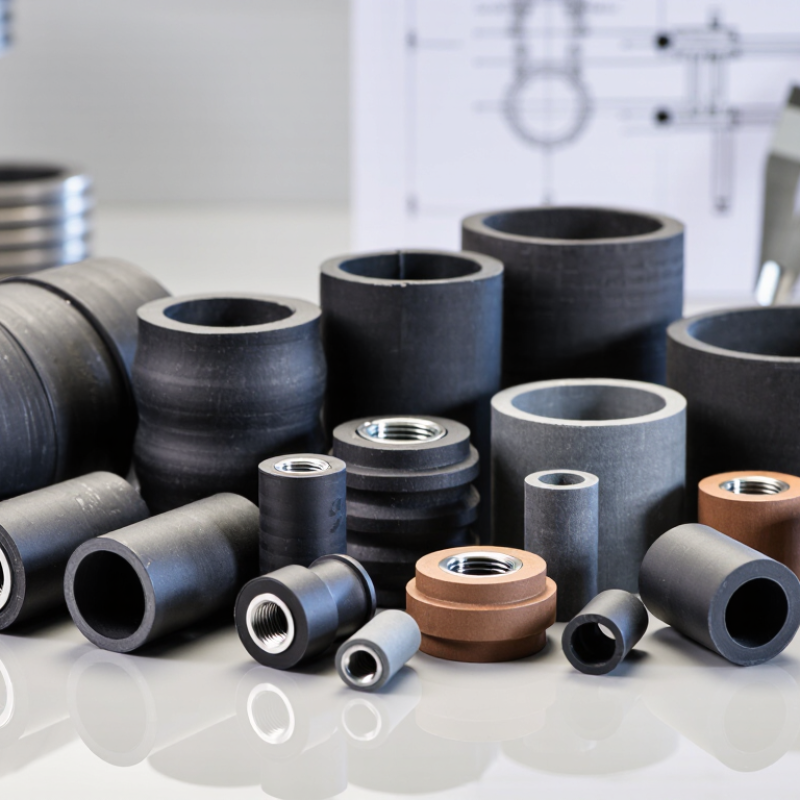
Rubber Bush Basics: Purpose, Structure, and Key Performance Features
2026 Best Rubber Bushes for Global Buyers?
Rubber Bush Basics: Purpose, Structure, and Key Performance Features
A rubber bush is a flexible sleeve that separates two moving parts. It reduces vibration, limits noise, and controls small alignment changes. In vehicle and industrial assemblies, it often sits between a metal inner tube and an outer shell. The rubber layer carries repeated loads while allowing controlled movement. This simple structure is easy to overlook. It should not be.
Performance depends on compound hardness, rubber quality, bonding, and geometry. Softer rubber usually absorbs more vibration, but may permit excessive movement. Harder rubber improves control, yet can transmit harsh impacts into the frame. Engineers should check radial load, compression, temperature range, chemical exposure, and working frequency. A bush exposed to oil, road salt, or heat needs suitable resistance. Dimensions matter too. A one-millimeter error can create preload, noise, or early tearing. From practical inspection, cracks near the sleeve edge often reveal misalignment rather than poor rubber alone. Field diagnosis is not perfect.
Tips: Measure the old part before ordering. Record inner diameter, outer diameter, width, and sleeve length. Request hardness data and tested operating temperatures. Review drawings, tolerance limits, and bonding requirements with the supplier. Do not judge quality by appearance alone. Press-fit force provides useful evidence. If installation feels unusually tight, stop and investigate. A small trial batch can expose fit problems before global shipment. That extra check may feel slow, but it often prevents expensive rework.
2026 Best Rubber Bushes for Global Buyers? - Rubber Bush Basics: Purpose, Structure, and Key Performance Features
| Evaluation Dimension | Rubber Bush Basics | Typical Data or Range | Why It Matters to Global Buyers | Common Verification Method |
|---|---|---|---|---|
| Primary purpose | A rubber bush is an elastomeric isolation and locating component used between two mechanical parts. | Controls movement while reducing vibration, impact, and structure-borne noise. | The correct bush should balance isolation, steering or positioning accuracy, durability, and comfort. | Application review, dimensional inspection, and functional testing. |
| Typical applications | Suspension arms, stabilizer bars, engine mounts, cab mounts, exhaust hangers, industrial machinery, and pipe supports. | Automotive, commercial vehicles, agricultural equipment, construction machinery, and general industrial systems. | Operating load, temperature, chemicals, and required service life vary greatly by application. | Application specification and duty-cycle analysis. |
| Basic structure | Usually consists of an elastomer body, one or more metal sleeves, bonding layers, and sometimes voids or interlocking features. | Common forms include cylindrical, bonded, split, flanged, tapered, spherical, and voided designs. | Structure determines stiffness direction, installation method, load capacity, and movement control. | Cross-section review, material identification, and visual inspection. |
| Elastomer material | Natural rubber and synthetic elastomers such as EPDM, nitrile rubber, chloroprene, and silicone may be selected according to service conditions. | Hardness commonly falls within approximately 40–90 Shore A, depending on design requirements. | Material choice affects oil resistance, weathering, temperature capability, damping, and fatigue life. | Material certificate, hardness test, chemical-resistance test, and aging test. |
| Static stiffness | Resistance to slowly applied displacement under a defined load. | Reported in N/mm or kN/mm; the required value is application-specific and directional. | Too soft can cause excessive movement; too stiff can transmit vibration and increase noise. | Compression, radial, axial, or torsional load-deflection testing. |
| Dynamic stiffness | Frequency- and amplitude-dependent resistance during cyclic or oscillating loading. | Typically higher than static stiffness; values must be stated with frequency, temperature, and amplitude. | Important for vibration isolation, ride quality, acoustic performance, and resonance control. | Dynamic mechanical analysis or forced-oscillation testing. |
| Damping capacity | The ability of the elastomer to dissipate mechanical energy as heat. | Often expressed using loss factor, damping coefficient, or hysteresis characteristics. | Higher damping can reduce resonance and vibration, but may increase heat generation and stiffness variation. | Hysteresis loop analysis and dynamic mechanical testing. |
| Temperature capability | Usable temperature depends on elastomer formulation, loading, exposure time, and surrounding components. | Many general-purpose designs operate around −40°C to +100°C; specialized compounds may extend beyond this range. | Incorrect temperature selection can cause hardening, softening, cracking, compression set, or premature failure. | High- and low-temperature aging, compression-set, and functional tests. |
| Environmental resistance | Resistance to water, ozone, ultraviolet exposure, road salt, oils, fuels, hydraulic fluids, and cleaning chemicals varies by compound. | EPDM generally provides strong weathering performance, while oil resistance requires a compatible elastomer. | Global buyers should match the compound to the actual fluid and climate exposure rather than rely on appearance alone. | Immersion, ozone, UV, salt-spray, and chemical-compatibility testing. |
| Fatigue durability | Ability to withstand repeated deformation without cracking, debonding, tearing, or permanent loss of function. | Life depends on strain amplitude, frequency, preload, temperature, contamination, and alignment. | A bush that passes static load tests may still fail under long-term cyclic service. | Accelerated cyclic endurance and post-test visual and dimensional inspection. |
| Compression set | Permanent deformation remaining after prolonged compression and recovery. | Lower compression set generally indicates better retention of shape under sustained compression. | High compression set can reduce preload, cause looseness, and change alignment over time. | Standard compression-set testing at specified temperature and duration. |
| Tensile and tear strength | Resistance of the elastomer to stretching and propagation of cuts or tears. | Reported as tensile strength, elongation at break, and tear strength; values vary by compound and cure system. | Critical for designs exposed to high strain, sharp edges, misalignment, or repeated articulation. | Tensile, elongation, and trouser or angle-tear testing. |
| Bonding and sleeve integrity | Bonded bushes rely on adhesion between rubber and metal; non-bonded designs rely on controlled interference, geometry, or retention features. | Bond failure, sleeve movement, corrosion, and rubber separation are key failure risks. | Reliable bonding and corrosion protection help maintain alignment and prevent noise or looseness. | Pull-out, torsion, peel, shear, and visual bond inspection. |
| Dimensional accuracy | Includes inner diameter, outer diameter, length, flange dimensions, void orientation, and installation tolerances. | Tolerance should be defined on the engineering drawing and checked at controlled conditions. | Incorrect dimensions can create installation damage, excessive play, abnormal stiffness, or premature wear. | Calipers, gauges, coordinate measurement, and incoming inspection plans. |
| Installation requirements | Installation may require controlled press-fit force, lubrication restrictions, orientation marks, pre-compression, and specified tightening conditions. | Assembly conditions should follow the design drawing and service instructions. | Correct installation is essential because twisting, over-pressing, or incorrect preload can shorten service life. | Assembly audit, press-force monitoring, torque verification, and alignment inspection. |
| Quality and traceability | A robust supply specification covers material batch, cure conditions, dimensions, performance tests, packaging, and change control. | Use documented inspection records, lot identification, sampling plans, and nonconformance procedures. | Traceability reduces supply-chain risk and supports consistent performance across different production lots. | Quality documentation review, audit, first-article inspection, and periodic requalification. |
Note: The numerical ranges shown are general engineering reference values. Final selection should be based on the component drawing, load spectrum, movement requirements, temperature, chemical exposure, installation conditions, and validated endurance testing.