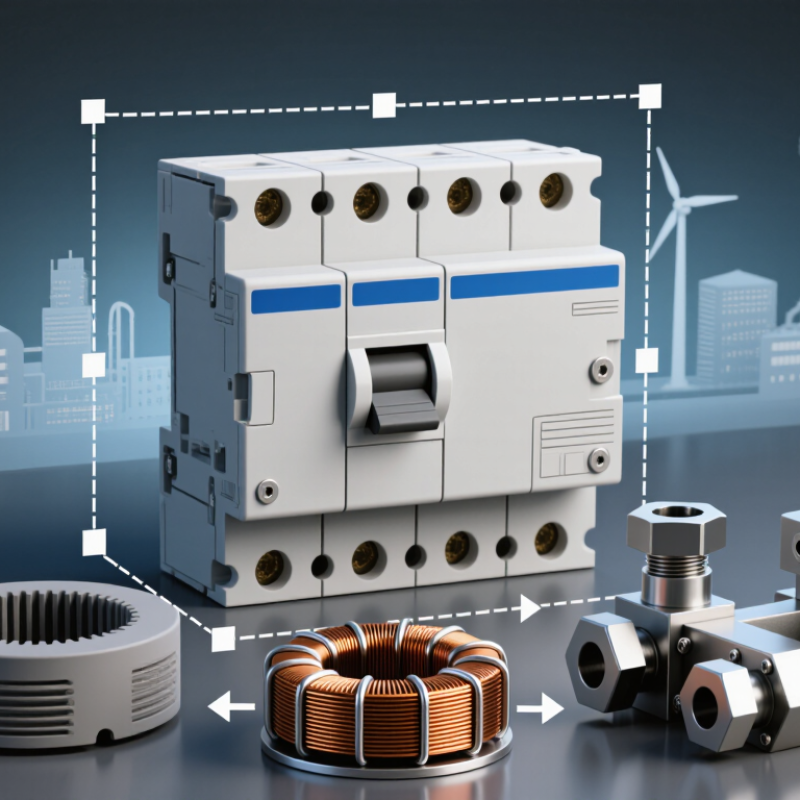
2026 Best Circuit Breaker Parts for Global Buyers
Global power systems are becoming more complex, and reliable protection depends on much more than the breaker enclosure. The IEA’s Electricity 2024 report forecasts global electricity demand growth of about 3.4% annually through 2026. More current flows mean greater pressure on contacts, trip units, arc chutes, terminals, and operating mechanisms. Small failures can stop an entire production line.
This is where Circuit Breaker Parts become commercially important. The right replacement part must match voltage, current, interrupting capacity, mounting dimensions, insulation requirements, and operating conditions. IEC 60947-2 and IEC 60898-1 provide important performance frameworks for low-voltage circuit breakers. UL 489 remains widely referenced in North American applications. Buyers should verify the exact standard before comparing prices.
The IEA’s Electricity Grids and Secure Energy Transitions report also highlights the need for stronger, more flexible grid infrastructure. That need reaches factories, buildings, renewable-energy sites, and data centers. A trip coil may look insignificant. It can determine whether protection operates on time.
This guide examines the 2026 best Circuit Breaker Parts for global buyers, including original, compatible, and customized options. It considers material quality, supplier documentation, testing records, lead times, and after-sales support. Not every low-cost part is unsafe, but unclear traceability creates avoidable risk. Market reports often measure breaker demand, not individual components. That limitation deserves attention. Experienced purchasing teams should combine published data with sample testing, dimensional inspection, and verified technical documents before approval.
Circuit Breaker Parts: Functions, Types, and Core Components
Circuit breaker parts determine how safely a protection device detects faults, interrupts current, and returns to service. For global buyers, each part must match voltage, current, frequency, and installation conditions. The trip unit senses overloads or short circuits and releases the mechanism. During panel inspections, technicians often check terminal heating, contact wear, and trip response. A warm terminal can indicate poor tightening or oxidation.
Circuit breaker types serve different protection needs. Thermal-magnetic breakers combine delayed overload protection with fast short-circuit release. Electronic trip units offer adjustable settings and clearer maintenance data. Residual-current devices detect leakage flowing away from the intended circuit path. They may not provide complete overcurrent protection, so system design requires careful review.
The fixed and moving contacts carry current during normal operation. Arc chutes divide and cool the arc when contacts separate. The operating mechanism stores energy and opens the circuit quickly. A weak spring can cause delayed interruption. Terminals connect the breaker to busbars, cables, or control wiring. Auxiliary contacts report open, closed, or tripped positions. Enclosures protect internal parts from dust, moisture, and accidental contact. For harsh environments, buyers should verify insulation, temperature limits, and mechanical endurance. Certification documents matter, but they do not replace sample testing. A catalog can hide fitment problems. That is where practical inspection remains essential.
How to Choose Circuit Breaker Parts for Different Applications
Choosing circuit breaker parts requires more than matching a product photograph. Check the breaker’s rated voltage, continuous current, interrupting capacity, pole count, and trip characteristics. These values must suit the application, not merely the panel space. A residential distribution board may need thermal-magnetic protection, while a motor circuit may require adjustable trip settings and stronger terminals. Fit matters.
For industrial equipment, inspect contact material, arc chute design, operating springs, auxiliary contacts, and shunt-trip coils. In humid or dusty locations, enclosure protection and corrosion resistance become important. Solar systems may require parts rated for direct current, because DC arcs behave differently from AC arcs. Marine installations demand careful attention to vibration, salt exposure, and insulation distance. Small details matter.
Global buyers should confirm dimensional drawings, terminal arrangements, temperature limits, and test documentation before ordering. Standards can differ by market, so verify the required certification with a qualified engineer or local authority. Field inspections often find loose terminals caused by incorrect torque, not defective parts. Replacement components should also be traceable by batch or production record. Not every similar-looking part is interchangeable. A useful review may expose uncertainty, especially when older breakers lack complete records. In that case, measuring twice and consulting the original technical file is safer than relying on appearance.
Key Standards and Compatibility Requirements for Global Buyers
2026 Best Circuit Breaker Parts for Global Buyers
Key Standards and Compatibility Requirements for Global Buyers
Selecting circuit breaker parts for global projects requires more than matching amperage. Buyers should confirm the applicable standard, voltage, frequency, and interrupting capacity. IEC 60947-2 commonly covers industrial circuit breakers, while IEC 60898-1 applies to many residential applications. Other markets may require national certification based on local installation rules. Fit matters.
Compatibility starts with the panel. Check pole count, frame size, terminal position, mounting method, and accessory interfaces. A replacement trip unit may look identical but fail to connect correctly. Verify whether the breaker uses thermal-magnetic or electronic protection. Confirm the rated current at the actual ambient temperature, not only the catalog value. A crowded enclosure can raise internal heat significantly.
Experienced buyers should request test reports, conformity documents, dimensional drawings, and batch traceability. Compare short-circuit ratings under the correct voltage and frequency. Do not assume a higher current rating provides safer protection. The cable size, busbar rating, and coordination study must support it. Measure twice.
Some product descriptions remain vague about auxiliary contacts or shunt releases. That creates delays during installation. I have seen projects pause because a mounting clip differed by a few millimeters. This is easy to overlook. Before ordering, send panel photographs, terminal measurements, and the intended installation environment to the supplier’s technical team. Their response should be specific, documented, and consistent with the applicable standard.
2026 Best Circuit Breaker Parts for Global Buyers — Key Standards and Compatibility Requirements
Typical nominal single-phase supply values are essential when checking a circuit breaker’s rated voltage, frequency compatibility, pole configuration, and applicable certification requirements.
Select a breaker with a rated operational voltage equal to or above the system’s nominal voltage.
Confirm that the breaker and connected accessories are suitable for 50 Hz or 60 Hz operation.
Common references include IEC 60898-1 for household breakers, IEC 60947-2 for industrial breakers, and UL 489 for North American applications.
Values shown are typical nominal public low-voltage supply values. Actual requirements can vary by country, installation type, local electrical code, and utility configuration. Verify the local authority requirements before purchasing.
Quality Testing, Safety Checks, and Supplier Evaluation
2026 Best Circuit Breaker Parts for Global Buyers
Quality Testing, Safety Checks, and Supplier Evaluation
Global buyers need more than a low unit price when selecting circuit breaker parts. A reliable part should show stable performance under heat, vibration, and repeated switching. In practical inspections, technicians check terminal pressure, contact alignment, insulation condition, and molded housing consistency. Small cracks matter. They can grow during transport or installation.
Quality testing should follow a documented process. Samples can undergo dimensional checks, dielectric strength testing, temperature-rise testing, and mechanical endurance trials. Test instruments need calibration records with dates and traceable references. Inspectors should compare results with approved specifications, not verbal promises. Photographs of labels, packing layers, and sample measurements improve evidence. Yet one sample cannot represent every production batch. That limitation deserves attention.
Supplier evaluation may require a factory visit or independent inspection. Buyers should review process controls, incoming-material records, corrective-action reports, and worker training. Ask how rejected parts are isolated. Ask who approves design changes. Clear answers build confidence. Delayed documents do not always mean poor quality, but repeated gaps are warning signs. A supplier may pass a sample test and still struggle with consistency.
2026 Best Circuit Breaker Parts for Global Buyers - Quality Testing, Safety Checks, and Supplier Evaluation
| Part or Assembly | Primary Function | Key Quality Parameters | Recommended Quality Tests | Safety Checks | Relevant Reference Standards | Supplier Evidence to Request |
|---|---|---|---|---|---|---|
| Thermal-Magnetic Trip Unit | Provides overload protection through thermal action and short-circuit protection through magnetic action. | Trip-current accuracy, response time, calibration stability, temperature compensation, and reset performance. | Overload trip test, instantaneous trip test, calibration verification, temperature-rise test, and endurance cycling. | Confirm that trip settings match the product rating and that the mechanism cannot be blocked or bypassed during normal use. | IEC 60947-2; IEC 60898-1 where applicable; UL 489 where applicable. | Calibration records, test curves, rated-current declaration, change-control procedure, and production traceability. |
| Electronic Trip Unit | Measures current electronically and controls adjustable long-time, short-time, instantaneous, or ground-fault protection. | Measurement accuracy, pickup tolerance, time-delay accuracy, power-up behavior, electromagnetic immunity, and firmware control. | Primary-current injection, secondary-current simulation, self-diagnostic test, power interruption test, EMC test, and functional endurance test. | Verify fail-safe behavior, correct status indication, password or setting protection, and safe operation after loss and restoration of auxiliary power. | IEC 60947-2; IEC 60255-26 for applicable measuring and protection functions; applicable EMC requirements. | Protection-setting range, software revision control, EMC reports, calibration method, and records for critical electronic components. |
| Arc Chute Assembly | Splits, cools, and de-ionizes the electrical arc during interruption. | Plate material, plate spacing, insulation distance, dimensional accuracy, heat resistance, and arc-containment integrity. | Dimensional inspection, insulation-resistance test, dielectric-strength test, thermal exposure test, and short-circuit interruption validation. | Check for cracked plates, missing separators, loose hardware, carbon tracking, and obstruction of arc exhaust paths. | IEC 60947-2; IEC 60898-1; applicable enclosure and dielectric requirements. | Material specifications, incoming inspection plan, dimensional-control records, and sample interruption-test results. |
| Fixed and Moving Contacts | Carry load current and separate to interrupt current when the breaker trips or is switched off. | Contact resistance, contact pressure, contact alignment, wear rate, plating or alloy consistency, and welding resistance. | Micro-ohm resistance test, contact-force measurement, mechanical endurance test, temperature-rise test, and short-circuit test. | Inspect for pitting, excessive erosion, misalignment, contact welding, and insufficient opening distance. | IEC 60947-2; IEC 60898-1; applicable material and plating specifications. | Contact-material declaration, resistance limits, wear criteria, endurance data, and lot-based inspection records. |
| Operating Mechanism and Latch | Stores and releases mechanical energy to close, open, and trip the breaker reliably. | Operating force, trip-free action, opening time, closing time, latch retention, lubrication, and mechanical endurance. | Manual and automatic trip tests, mechanical endurance cycling, vibration test, shock test, and timing measurement. | Confirm that the breaker trips even when the handle is held in the ON position and that re-closing cannot occur unintentionally. | IEC 60947-2; IEC 60898-1; applicable mechanical endurance requirements. | Endurance-cycle results, mechanism drawings, lubricant specification, tolerance plan, and failure-mode analysis. |
| Insulating Housing and Barriers | Separates live parts and provides mechanical protection and arc containment. | Insulation strength, comparative tracking performance, flame resistance, dimensional stability, impact resistance, and creepage distance. | Dielectric-strength test, insulation-resistance test, glow-wire or flammability test where applicable, impact test, and dimensional inspection. | Check for cracks, flashover marks, sharp edges, inadequate barriers, exposed live parts, and blocked pressure-relief features. | IEC 60947-2; IEC 60695 series where applicable; IEC 60898-1; UL 489 where applicable. | Resin grade and flammability documentation, mold-control records, insulation test results, and dimensional inspection reports. |
| Terminals, Lugs, and Terminal Screws | Connect the circuit breaker safely to conductors or busbars. | Conductor range, torque capability, clamping force, conductivity, corrosion resistance, and resistance to pull-out. | Torque test, pull-out test, temperature-rise test, wire-retention test, corrosion evaluation, and repeated connection test. | Verify torque markings, compatible conductor sizes, correct hardware, anti-loosening features, and protection against accidental contact. | IEC 60947-1; IEC 60947-2; IEC 60898-1; applicable national wiring rules. | Terminal drawings, torque values, conductor compatibility list, material certificates, and routine torque-inspection records. |
| Auxiliary and Alarm Contacts | Provide remote indication of breaker position, trip status, or alarm condition. | Contact arrangement, electrical rating, insulation resistance, dielectric strength, switching reliability, and terminal identification. | Continuity test, contact-resistance test, dielectric-strength test, switching endurance test, and signal verification. | Ensure control wiring is isolated from power circuits and that alarm indication cannot be confused with normal OFF status. | IEC 60947-5-1 where applicable; IEC 60947-1; applicable control-circuit requirements. | Wiring diagrams, contact ratings, terminal coding, functional test records, and compatibility information. |
| Shunt Trip and Undervoltage Release | Enables remote tripping or automatic tripping when the control voltage is removed or falls below the specified level. | Coil voltage, operating range, response time, insulation, temperature rise, and reset or re-closing behavior. | Voltage-range test, trip-time test, dielectric-strength test, temperature-rise test, endurance test, and power-loss simulation. | Confirm that the release voltage is correct and that unexpected loss of control power cannot create an unsafe re-energization condition. | IEC 60947-2; IEC 60947-1; applicable control-circuit standards. | Coil specifications, operating thresholds, wiring diagrams, test limits, and verified compatibility with the breaker assembly. |
| Calibration, Final Assembly, and Packaging | Ensures that all parts are assembled, adjusted, identified, protected, and delivered in usable condition. | Assembly consistency, product labeling, serial or lot traceability, calibration status, moisture protection, and impact protection. | Routine dielectric test, insulation-resistance test, operating test, trip test, visual inspection, label verification, and packaging-drop test. | Confirm correct ratings, warning labels, terminal covers, installation instructions, tamper evidence, and absence of loose components. | IEC 60947-1; IEC 60947-2; IEC 60898-1; applicable conformity-assessment requirements. | Quality plan, certificate of conformity, routine-test report, traceability sample, nonconformance records, and packaging specification. |

Buyer evaluation note: Confirm the required voltage, current, interrupting capacity, pole configuration, frequency, trip characteristics, installation environment, and applicable national certification before approving any circuit breaker part or assembly.
2026 Buying Guide: Pricing, Logistics, and After-Sales Support
For global buyers, circuit breaker parts pricing starts with technical fit, not the lowest quotation. Contacts, trip units, arc chutes, terminals, and molded cases require exact ratings and compatible dimensions. IEC 60947-2 should guide low-voltage verification. The IEA Electricity 2024 report projects global electricity demand growth of about 4% in 2024 and 2025, increasing pressure on dependable maintenance supply. Ask for material specifications, inspection records, batch traceability, and sample approval before placing volume orders.
Freight is not fixed. UNCTAD reports that maritime shipping carries over 80% of world merchandise trade by volume. A small delay can stop a production line. Compare air, sea, and multimodal options using landed cost, not unit price alone. Include packaging, insurance, customs documents, Incoterms, and destination handling charges. The World Bank’s Logistics Performance Index 2023 also shows substantial differences in customs, infrastructure, and delivery reliability across markets. Build buffer stock for remote sites. It costs more upfront.
After-sales support should be written into the purchase contract. Require a response time, failure-analysis process, replacement rules, and access to installation guidance. Keep serial numbers and test reports linked to each shipment. That detail saves hours during troubleshooting. Still, no checklist is perfect. My procurement reviews have found that buyers sometimes overvalue certificates and undervalue communication speed. A supplier may pass inspection yet respond slowly after delivery. Test one pilot batch, review its field performance, and adjust future orders using real failure data.